Choosing reliable equipment suppliers is one of the most important decisions for any Coffee Shop investor. China has a broad manufacturing base for espresso machines, grinders, brewers, refrigeration units, display counters, and water treatment systems. However, product variety alone does not guarantee dependable performance. Global buyers need evidence, not attractive catalogs.
This guide examines China’s leading coffee equipment suppliers through practical buying criteria. It considers manufacturing experience, product specialization, quality control, export capability, and after-sales support. Factory audits, technical documents, certifications, and sample testing can reveal important differences between suppliers. A polished showroom may hide inconsistent assembly or limited spare-part availability. Look closely.
Professional buyers should also compare heating stability, grinder calibration, electrical compatibility, warranty terms, packaging strength, and installation guidance. These details matter when equipment travels thousands of kilometers before reaching a busy café. Supplier communication is equally important. Clear drawings, responsive engineers, and accurate lead times reduce costly misunderstandings. Still, no shortlist is perfect. Some supplier information may remain incomplete, especially when public records are limited. That limitation deserves honest attention.
The following overview is designed to support informed sourcing, not rushed purchasing. It combines industry-focused evaluation with practical observations from international equipment procurement. Buyers should verify current certifications and local compliance requirements before placing orders. A strong supplier is more than a low-price manufacturer. It should be a dependable technical partner. Steady results matter.
China’s coffee shop equipment suppliers are not defined by factory size alone. A credible supplier combines engineering, export experience, testing, and service support. The International Coffee Organization reported global coffee consumption of about 177 million 60-kilogram bags in 2023/24. This growth increases pressure on cafés to secure stable equipment, not merely attractive prices.
For global buyers, a qualified Chinese supplier should explain boiler capacity, pump pressure, heating recovery, electrical standards, and cleaning requirements. Product drawings should match the final quotation. Factory audits can verify stainless-steel quality, welding points, spare-parts storage, and testing records. The USDA Foreign Agricultural Service’s 2024 China Coffee Annual describes continuing expansion in China’s coffee consumption and café culture. That trend creates demand for grinders, brewers, filtration systems, refrigeration units, and compact water treatment equipment.
Small details matter. Ask for temperature logs, packaging photographs, and replacement-part lead times. Require manuals in clear English. Confirm certification requirements for the destination market. A supplier’s response to a failure is often more revealing than its sales presentation. I would not treat a polished catalog as proof of technical strength. Some factories communicate well but outsource critical components without explaining the arrangement. That weakness can increase maintenance delays. A practical evaluation should compare sample performance, inspection evidence, warranty terms, and after-sales access. Price still matters, but an inexpensive machine with unstable heating can quietly raise labor costs and damage beverage consistency.
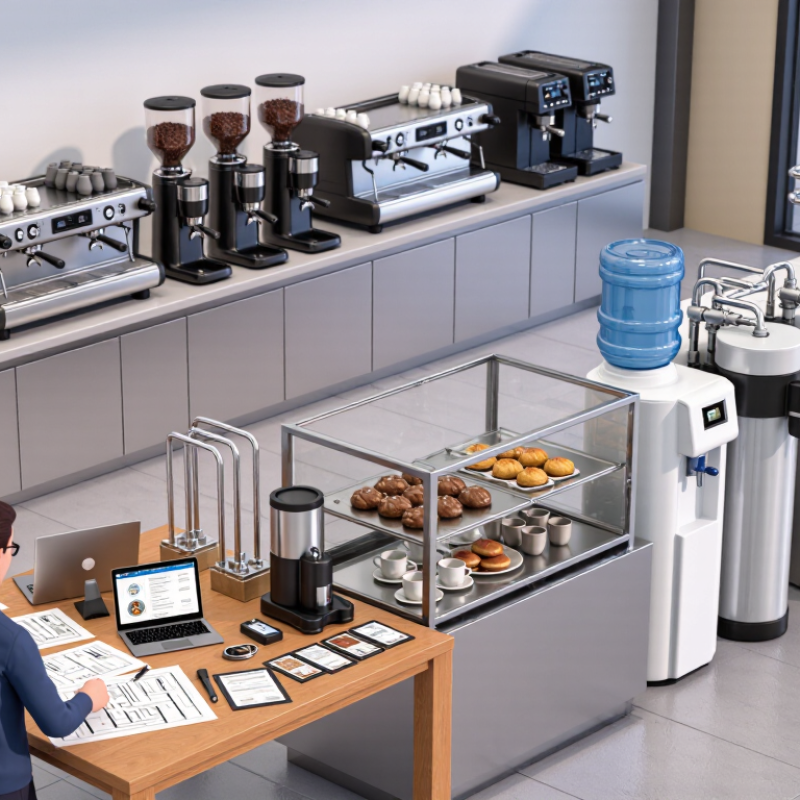
Chinese manufacturers now supply complete coffee-shop equipment packages, from compact counters to high-volume production lines. Key categories include commercial espresso machines, grinders, batch brewers, cold-brew systems, ice makers, water filtration units, and refrigeration. Each category solves a different service problem. Espresso machines control pressure and temperature, while grinders determine dose consistency and extraction speed. Small details matter, such as a 58-millimeter portafilter, dual boilers, or an easily removable drip tray.
The International Coffee Organization reported global coffee consumption of about 177 million 60-kilogram bags in 2023/24. This expanding demand increases pressure on cafés to serve quickly and consistently. According to the 2024 IMARC Group Coffee Machine Market Report, automation and energy efficiency remain important market drivers. Chinese suppliers commonly offer programmable dosing, touch controls, stainless-steel work surfaces, and modular replacement parts. Filtration equipment also deserves attention. Hard water can damage boilers and flatten espresso flavor within months.
Price is not the whole calculation. It rarely is. Buyers should verify electrical standards, heating recovery time, noise levels, warranty terms, and local service capacity. A grinder may look impressive but perform poorly during a crowded morning. Product samples, factory inspections, and documented testing reduce that risk. Certifications should be checked against the destination market, not accepted from a sales sheet alone. The difficult part is matching equipment to real workflow; many purchasing decisions still underestimate staff training and cleaning time.
Chinese manufacturers commonly offer complete coffee-shop equipment portfolios, including espresso machines, grinders, batch brewers, coffee roasters, ice makers, and commercial blenders. The chart compares typical commercial electrical input ranges by equipment category. Actual specifications vary by capacity, configuration, and market voltage.
Evaluating coffee shop equipment requires more than checking photos or a low quotation. Inspect materials, welds, seals, and moving parts closely. Stainless steel surfaces should feel smooth, without sharp edges or uneven polishing. Ask for test reports covering food-contact safety, electrical protection, and electromagnetic compatibility. Confirm that documents match the exact model, voltage, and destination market. Generic certificates are not enough.
Production capability also matters. Request factory videos, process records, inspection points, and recent capacity data. A reliable supplier can explain how it controls heating accuracy, pressure stability, and leak testing. Review sample units under realistic workloads. Ask how defects are recorded and corrected. A polished sample may hide inconsistent batch quality. This remains a common weakness in supplier evaluation.
Visit the factory when possible, or use an independent inspector. Check serial-number traceability, spare-part availability, packaging strength, and warranty procedures. Compare claimed output with actual production evidence. Keep written specifications signed by both parties. Do not accept vague promises. Even careful buyers can overlook after-sales response time, so test communication before placing a large order.
China’s coffee equipment suppliers compete through price, customization, and minimum order quantities. The International Coffee Organization’s Coffee Report and Outlook 2024 estimated global consumption at 177.9 million 60-kilogram bags in 2023/24. This demand encourages factories to offer flexible solutions. A standard commercial espresso machine usually costs less than a customized model. Custom colors, voltage settings, private labels, and redesigned steam systems can add tooling, testing, and packaging expenses. Sometimes, the “cheapest” quotation excludes spare parts or installation support.
MOQ matters more for customized orders. Standard grinders or brewers may be available in small batches, while customized machines often require 20 to 100 units. Buyers should request a written breakdown of mold fees, sample charges, warranty terms, and replacement-part availability. The International Trade Centre’s Trade Map supports checking product classifications and import patterns before comparing quotations. That step can expose unrealistic shipping assumptions. I have seen buyers focus too heavily on unit price. It is a mistake, though not always an obvious one. A lower price may reflect thinner metal, fewer heating cycles, or weaker quality control. Ask for test records, electrical certifications, water-contact materials, and production photographs. The Specialty Coffee Association’s technical guidance also emphasizes consistency, temperature control, and serviceability, not price alone. Small cafés may benefit from low-MOQ standard equipment. Large chains usually gain more from customization and negotiated after-sales support.
Importing Coffee Shop Equipment from China for Global Markets requires more than comparing catalogue prices. The International Coffee Organization reported global coffee consumption at about 177.9 million 60-kilogram bags in 2023/24. That demand supports wider café investment, but buyers still need market-specific equipment plans. A compact espresso station may suit a Bangkok kiosk, while a high-volume café in London needs stronger electrical protection, ventilation, and wastewater planning. Specifications matter.
A reliable sourcing process starts with a written equipment schedule. Include voltage, frequency, plug type, materials, capacity, dimensions, packaging, spare parts, and warranty terms. Ask suppliers for factory test records, food-contact declarations, and electrical safety documents. Verify whether products meet destination requirements, such as European conformity rules or North American certification needs. The International Trade Centre also emphasizes accurate customs classification for smoother cross-border trade. A low quotation can hide costly compliance gaps. This happens often.
Tips: Request a sample unit before placing a container order. Test heat recovery, noise, cleaning access, and actual power consumption. Photograph internal wiring and stainless-steel joints during inspection. Confirm carton strength after a simulated drop test. Do not trust one inspection report alone. Independent verification is useful. Leave budget for local installation and technician training. In practice, some buyers overfocus on appearance and underestimate water quality, drainage, and replacement seals. That oversight can interrupt service within months. Recheck every assumption.
| Equipment Category | Typical Commercial Specification | Common Materials | Typical Power Supply | Indicative FOB China Price Range | Typical Lead Time | Common MOQ | Key Export Considerations |
|---|---|---|---|---|---|---|---|
| Commercial Espresso Machines | 1–4 groups; 2–16 L boiler capacity; approximately 100–600 cups per day depending on configuration | Stainless steel body, copper or stainless-steel boiler, brass or stainless-steel fittings | 220–240 V, 50 Hz; some models available in 110–120 V, 60 Hz | US$900–US$8,000 per unit | 20–45 days | 1–5 units | Confirm voltage, plug type, pressure settings, water connection, electrical certification, and spare-parts availability |
| Coffee Grinders | Commercial burr grinders; 1.2–2.5 kg hopper; approximately 2–7 g/s grinding output | Aluminum alloy housing, hardened steel or coated burrs, food-contact plastic hopper | 220–240 V or 110–120 V; typically 250–1,000 W | US$120–US$1,200 per unit | 15–35 days | 2–10 units | Check burr diameter, grind adjustment, retention control, timer accuracy, noise level, and local electrical compliance |
| Coffee Roasters | 1–30 kg batch capacity; gas or electric heating; manual or software-assisted roast profiling | Stainless steel drum, steel frame, heat-resistant glass, insulated panels | 220–240 V or 380 V; heating may use gas, electricity, or both | US$2,500–US$25,000 per unit | 30–75 days | 1 unit | Review ventilation, exhaust, fire safety, gas regulations, burner type, emission controls, and installation requirements |
| Batch Brewers | 3–15 L brewing capacity; programmable brew cycles; insulated serving vessels or thermal dispensers | Stainless steel water tank, food-grade polymer components, glass or stainless-steel servers | 1,500–3,000 W; 110–120 V or 220–240 V | US$250–US$2,500 per unit | 15–40 days | 1–5 units | Verify brewing temperature range, water filtration compatibility, plug configuration, and food-contact documentation |
| Pour-Over Coffee Stations | Single or multi-station systems; 1–4 L water capacity; manual or temperature-controlled dispensing | Stainless steel, borosilicate glass, food-grade silicone, and heat-resistant polymers | 300–2,000 W for heated systems | US$80–US$1,000 per station | 15–30 days | 5–20 sets | Confirm countertop dimensions, heating control, replacement glassware, and compatibility with local power standards |
| Water Filtration Systems | Under-counter or inline filtration; approximately 1,000–10,000 L cartridge capacity | Polypropylene housings, activated carbon, ion-exchange resin, stainless-steel or polymer fittings | Usually non-electric; optional pumps may require 110–240 V | US$50–US$1,500 per system | 10–30 days | 5–20 sets | Match filtration performance to local water hardness, flow rate, pressure, cartridge standards, and sanitation requirements |
| Ice Makers | 20–300 kg ice production per 24 hours; air-cooled or water-cooled models | Stainless steel cabinet, copper tubing, food-grade ice bin insulation | Typically 220–240 V or 110–120 V; approximately 300–2,000 W | US$400–US$4,500 per unit | 20–45 days | 1–5 units | Check refrigerant type, ambient-temperature rating, drainage, water quality, climate suitability, and energy efficiency |
| Commercial Blenders | 1.5–2.5 L container; high-speed motor; suitable for smoothies, frappes, and cold beverages | Polycarbonate or stainless-steel container, stainless-steel blades, ABS or metal housing | 1,000–2,500 W; 110–120 V or 220–240 V | US$100–US$900 per unit | 15–35 days | 2–10 units | Evaluate noise enclosure, thermal overload protection, jar durability, blade replacement, and electrical safety approvals |
| Refrigerated Display Cases | 1–3 m display length; approximately 2–8°C operating temperature; front or rear access | Stainless steel base, tempered glass, aluminum frame, insulated polyurethane panels | 800–2,500 W; 110–120 V or 220–240 V | US$700–US$5,000 per unit | 25–60 days | 1 unit | Confirm refrigerant compliance, ambient operating range, defrost method, drainage, packaging protection, and door orientation |
| Dishwashers and Glasswashers | Undercounter or hood-type units; approximately 20–60 racks per hour | Stainless steel wash chamber, stainless spray arms, heat-resistant seals | 3,000–12,000 W; 220–240 V or 380 V depending on model | US$1,500–US$8,000 per unit | 30–60 days | 1 unit | Check water hardness, drain height, rinse temperature, chemical dosing, electrical load, and installation space |
| Stainless-Steel Café Furniture | Work tables, sinks, shelving, counters, and customized service stations | 304-grade stainless steel for wet or food-preparation areas; 201-grade steel for selected dry applications | Not applicable unless integrated with electrical equipment | US$80–US$3,000 per piece | 20–50 days | 1–10 pieces | Provide detailed drawings, confirm steel grade, edge finishing, drainage, knock-down packaging, and container loading plan |
| Packaging and Smallwares | Paper cups, lids, takeaway containers, pitchers, tampers, scales, and bar tools | Food-grade paper, coated board, stainless steel, borosilicate glass, silicone, and approved polymers | Generally non-electric; scales and small devices vary by model | US$0.03–US$150 per item, depending on type and quantity | 10–35 days | 500–10,000 pieces for printed packaging; 10–100 pieces for tools | Check food-contact regulations, printing inks, carton strength, moisture resistance, labeling, and destination-market recycling rules |
Common options include espresso machines, grinders, batch brewers, cold-brew systems, ice makers, filtration units, and refrigeration. Small counters can use compact packages.
Match boiler capacity, pressure control, temperature stability, and recovery speed with expected order volume. Dual boilers may support busy service. Do not judge by appearance alone.
Grinders control dose consistency and extraction speed. A stylish grinder may still struggle during a crowded morning. Test real workflow before ordering.
Record voltage, frequency, plug type, dimensions, materials, capacity, packaging, spare parts, and warranty terms. Small omissions become expensive later.
Hard water can damage boilers and weaken espresso flavor within months. Check local water conditions before installation. This step is easy to underestimate.
Request a sample unit and measure heat recovery, noise, cleaning access, and actual power consumption. Photograph wiring and stainless-steel joints during inspection. One test is not enough.
Verify electrical and food-contact documents against the destination market’s requirements. Confirm accurate customs classification before shipment. A sales sheet is not proof.
Budget for local installation, technician training, replacement seals, drainage, and possible electrical upgrades. Container prices can look attractive. The real calculation is harder.
China has become a major source of coffee shop equipment for global buyers, offering a broad selection of machines, grinders, brewing tools, refrigeration units, display cases, sinks, furniture, and supporting accessories. Chinese manufacturers can serve small cafés, restaurant groups, hospitality projects, and large commercial developments, with options ranging from standard products to customized solutions. Buyers should assess material quality, manufacturing experience, production capacity, inspection procedures, certifications, and after-sales support before placing an order.
Pricing, customization, and minimum order quantities vary by supplier and product category. A careful comparison should include specifications, samples, packaging, lead times, payment terms, warranty conditions, and replacement-part availability. International buyers should also confirm product compatibility with local voltage, plugs, safety requirements, labeling rules, and import documentation. By selecting a reliable supplier and planning logistics in advance, businesses can control costs while obtaining durable, compliant, and practical equipment for their Coffee Shop projects in different global markets.

HUA KE HOUSE